Showing posts with label bicycling advocacy. Show all posts

Thursday, September 18, 2008

Notes of organizing meeting on 11SEP2008


TAOBIKE_GC ORGANIZING MEETING

11SEP2008

7PM

MARTIN EAST REGIONAL LIBRARY

TULSA

OKLAHOMA


THE NEXT MEETING WILL BE HELD ON OCTOBER 9th AT THE HUB (216 N ELGIN) AT 7PM.


Attending:

Ed Wagner

Doug Waldman

Chris Wollard

Steve Monroe

Julie Vega

Paul Tay

George Hall

Mike Schooling

Tom Brown

Richard Hall

Vickie Sanborn

Brian Potter

Ren Barger

Rhonda James

Robyn Stroup

Chris Regan

Andy Wheeler


Some quotes:


On bicycle commuting, "I could go a shorter route if I wanted to risk the roads."


"When I drive my car, I'm grouchy and miserable when I get home."


Rich Brierre is now Director of INCOG.


Tulsa Streets package vote will be held in November. Cyclists need to be in on the planning process up front rather than as an expensive afterthought.


We need to establish a board to work with INCOG on planning. INCOG has stipulations as to representation which was the heart of original organizing document. The INCOG bicycling subcommittee was geographically diverse, skills diverse, not 'wheelmen' running everything. (In the public vernacular, 'wheelmen' are all those cyclists in lycra, not just the Tulsa Wheelmen. It's a derisive shorthand for cycling elitists. More on this later.)


Richard Hall asked, "What do we do if he says 'we don't want you.'" (THIS QUESTION IS YET TO BE ANSWERED.)


We talked about planning and planning documents, where the devil is always in the details. A plan that looks good on a webpage can have nightmarish details at the street level because planners simply draw lines between points. Public Works wants to do cycling projects as simply and cheaply as possible.


Paul Tay wants to find unique solutions for Tulsa. He noted bikePortland.org as a source of information, and wanted stuff thats beyond spandex.


George Hall, a forensic engineer, investigates accidents including bicycle accidents. He is a lifelong cyclist and League of American Bicyclists Life member old enough to persist in calling it LAW, the League of American Wheelmen. "My bikes are almost as old as me." George is interested in safety. He is a civil engineer with a design perspective. He is frustrated at the pace here in Tulsa. A former commuter, George says the time is now with the energy situation, the emphasis on environment, and Complete Streets, though they probably don't know what that truly means in terms of the national organization. Frustrated that word doesn't get down to surrounding cities where we all ride, as there is no organized mechanism to get info to city planners.


Richard Hall (no relation) is a Tulsa Bicycle Club member and President Elect of the Oklahoma Bicycling Coalition. He's encountered problems in his own neighborhood with PW projects, and noted that after work has been approved and built, it is very hard to change.


Mike Schooling endorsed best practices. Mike is another TBC member very active in volunteer work with the Tulsa Tough where he has organized the group assembling bicycles as part of the Kids Challenge. He wants to improve environment for cycling, and notes that Tulsa is already a bicycling friendly city in many ways. He said that Chicago's Mayor Daley rides with Public works on his bike, and that we should do the same with Tulsa councilors. Mike said there are lots of studies touting bike lanes, but none yet that indicate what other facilities do to promote cycling. What effects result from projects such as good signals that detect cyclists, education, enforcement? Cities should be promoting cycling, because what benefits cyclists benefits motorists also. Tulsa doesn't have the money for extensive facilities, so we have to find solutions that work here.


Tom Brown of Tom's Bicycles thinks this group should position itself as the go to experts in this part of OK. These poiticians and planners really don't know what we want, so we have to convince them to listen to us. We can give them useful advice.


Rhonda Link - Ren's mother - wants to see cycling etiquette and education. Noted that an acquaintance single handedly brought bike paths to his town. Offered to assist with vision and fund raising.


Robyn Stewart wants to use bike as basic transportation. She sees more people biking downtown, more than she's ever seen before.


Julie Vega arrived with Ren and is learning more about the HUB. Rode in SF for a year, but finds it kind of scary here. She said there's no specified place to ride and doesn't feel comfortable riding a bike on the road. She wants changes in city laws and wants to do what she can as part of the community.


Steve Monroe wasn't sure what aspect he could do, but came to learn.


Doug Waldman, business owner, commutes from south Tulsa to near the airport, a distance of 23 miles. He takes a relaxing route rather than fight traffic, riding when he can. He puts in thousands of miles back and forth to work and finds Tulsa is not a bad place to ride. "I merge into traffic, but don't fit on Memorial or 169, and people are confused that I stop at sto signs." 99 percent of drivers are friendly. You don't have to spend a lot of money. Bike lanes don't go where you want to go anyway. People think that in a bike lane you don't have to stop.


Vickie Sanborn wasn't entirely sure why she attended, but said her interest is in bicycling safety and more education for people on bikes, both adults and children. She told us of visiting her son in Minneapolis. They were riding on a trail and came to an intersection. Her son 'flew across the street' without stopping. she was shocked, but he said that the law requires motorists to stop - not bicyclists - and the motorists actually yield to cyclists. It was amazing. Vickie is a realtor who commutes on bike, and she'd like to show houses via bicycle as some realtors do in bike friendly communities.


Brian Potter witnessed poor bicycle planning and hostile drivers in Austin TX. He terms the city of Tulsa becoming less courteous than previously. Brian asked that this be added: "Only the native Okie courtesy has kept our roads remotely civilized...Unfortunately, we're losing our native courtesy at a rapid rate. The pavement needs help, but the continuity of streets and availability of routes is really quite astounding." He gave much credit to both Malcolm McCollam and Gary Parker for the on-street route system and establishing the first INCOG bicycling subcommittee. Brian said that he and Sandra Crisp became involved in the plan after it had been taken away from cyclists. It called for mandatory sidewalk riding, for one. The BAG made an important contribution. Brian also noted that Tulsa had more LCIs than rest of the state.


Chris Wofford termed himself as "part of Ren's army."


Ren Barger said that she's usually the youngest person at these meetings. As a student in Chicago, she did "jalopy riding, sidewalk riding, and was completely clueless." A bad crash ultimately brought her home to Tulsa, where she works at Lee's Bicycles. Involvement in the Tulsa Tough lead to LCI training. She like the big festivaland its youth element, the Kids Challenge. Ren took over the Community Cycling Project from Sandra Crisp, rehabing donated bikes for transients and providing them with bicycling education. This is based on a Portland program and is designed for commuting. It has been very successful, but was unfortunately formant for about 6 months. An Urban Tulsa piece sparked fresh interest. The Tulsa Community Foundation offered a building at 216 N Elgin (corner of elgin and brady near spaghetti warehouse) for the Tulsa HUB, ultimately to be a 501c3 with space for the CCP, a retail shop catering to commuters and recreational riders. This is to be a sustainable business that promotes creativity, but it must be Tulsa specific, not a template taken from another city.


Ed Wagner, a lifelong bicycle commuter, moved here from Pittsburgh and discovered that motorists are accomodating for the most part. Was a 'gutter bunny' commuter when first met Brian, hugged the right hand verge and complained of motorists. I'd been riding for a long time, yet the demonstration of lane postioning was an eye-opener. It was so much easier. Shortly after that I attended a Road1 course. Brian was instrumental in setting up both Road1 and the LCI class here in Tulsa. LCI is about teaching, not knowing everything about cycling. I've learned much from waching others, especially Gary and Ren. Some of us learn via experience, and I'm a a slow learner at times.


Some background information: The INCOG bicycling subcommittee had its second interation under Aaron Bell. When he left, the committee fell apart. Patrick Fox lead an informal committee. Now, bicycling advocacy in Tulsa is this group, a small group of interested people. There are different levels to get involved. We have regional and national advocacy. OBC is the state level group, whose main focus is education and legislation. Access. safety, and education are part of their mission statement. OBC is small and diverse. LAB is the national organization. It runs on a shoestring budget of 1.5 million last year. LAB runs the Bike Friendly City program, and certifies the Bike Ed program. The city of Tulsa (specifically the mayor) is interested in BFC status. We regard BFC, Tulsa Tough, and a comprehensive bicyle master plan as parts of a whole. They are interrelated. Tulsa wants BFC status to attract young people for employment. The Tulsa Tough highlights the city as a cool place to live for those with an outdoor lifestyle. The Tough is an opportunity for both bike education and public relations. It's a big effort each spring. The lack of a comprehensive bike master plan was one reason BFC status was denied last year. There is a trail plan on INCOG maps, but a master plan specifies our vision for cycling in city. We need share the road signs, signals that recognize cyclists, etc. INCOG wants input from citizens, and you're citizens. You should have input as to how this impacts your life.


Mike Schooling mentioned PlaniTulsa.org as an opportunity for input. It will be held on Sept 22 and 23 and is meant to solicit planning regrading city development and provide a long range plan. Each table will have a map with stickers highlighting various ideas. It's recommended that cyclists be spread out, not clustered at one table. Mike recommended getting friends, relatives, etc. at the tables. What works well for motorists works for cyclists too, and doesn't necessitate a lot of dollars.


This new organization - if it is to be an organization - doesn't have a name yet. TAOBIKE can offer advocacy leadership and ultimately it may be one organization with 2 wings: one for advocacy and planning, and the other for BikeEd. Since it's a small group, there's little sense in splitting in two, and there will be lots of crossover as we seek to educate motorists, politicians, planners, law enforcement and even cycling advocates. We cannot afford a pie-in-the-sky approach that's not grounded in reality. We face many constraints. But it's good that we have more poeple than we have positions (on the subcommittee/BAG).


In a brief conversation with Rich Brierre, I said that the cycling subcommittee dies each time INCOG has a personnel change. What if we establish an outside group to do the function of that subcommittee, supplying expertise and knowledge. Rich said that if it's a "representative group" he could work with it. The group must have more than one point of view.


Mike asked, "What do we want to be when we grow up?" Some discussion ensued as to what to call ourselves, what our authority would be, and what the makeup of the group would be. Paul wanted 9 members (on the advisory group) each from one of Tulsa's 9 council districts. This would limit the group to Tulsa only, and there was some discussion of regional goals. Paul rightly pointed out that the group should be able to take on any cycling issue it chooses.


Also, there is a list of no cost/low cost ideas compiled by Gary Parker that may be useful in the PlaniTulsa meetings. It will be circulated to the group.


ED WILL WORK ON BYLAWS.


PAUL WILL WORK ON COMPREHENSIVE MASTER PLANS. Brian suggested keeping it short and simple, essentially LAB's 5 Es: engineering, education, enforcement, encouragement, equality, and evaluation. If we can get the City of Tulsa to adopt a bicycling master plan, INCOG may be able to sell that to the other regional members.


THE NEXT MEETING WILL BE AT THE HUB (216 N ELGIN) ON OCTOBER 9TH AT 7PM.


.

Tuesday, September 9, 2008

Proposed Agenda for Thursday's Meeting

Agenda Items


A brief history of TAOBIKE

Malcolm McCollum and the first BAG

The ad-hoc committee of volunteers/ on-street planning/the usual suspects

Aaron Bell and the bicycling subcommittee

Patrick Fox and the informal bicycling subcommittee

Initial Road1 class due to Brian's efforts

Initial LCI class. It's not a certification that we know everything about cycling. It's a certification that we can teach what we know.

Recent addition to the local advocacy effort – The Hub – Ren Barger to lead.


INCOG bicycling subcommittee and functions

Why are we here today?

We are looking specifically for people who can work with INCOG on regional planning, and on the proposed Comprehensive Bicycling Master Plan ( a BFC requirement). INCOG requires a representative group for such planning. We must recognize that the available pool of people willing to commit time to bicycling advocacy is quite small, therefore this committee will still be self-selected to some extent. The usual suspects again.

INCOG's original organizing document addressed representation as follows:


The Advisory Group shall be composed of 9 voting members: A Chairman, one representative from the Tulsa Bicycle Club, one representative from the Tulsa Wheelmen, one representative from an area bicycle shop, one representative from the suburban cycling community, a representative from the Oklahoma Bicycling Coalition, one bicycle commuter appointed by the Chairman, a member at large appointed by the Chairman, and a representative from one of the area corporate bicycle commuter programs.


Regional and national bicycling advocacy: an overview of OBC and LAB

LAB is the national advocacy organization. They oversee the BikeEd program and lobby for bicycling at the federal level. They confer BFC status. Tulsa wants BFC status. We have an opportunity to accomplish that due to some unique factors here. 1. Average 5 mile commute. 2. Favorable topography and street grid system. 3. Motorists more accommodating than in other cities.


The Oklahoma Bicycling Coalition is the state advocacy organization. They offer some education support, lobby for bicycling at the state level, and pursue other projects like SRTS.


Bicycling education for advocacy

This is separate from BikeEd. An advocate must know the best practices in cycling. This is twofold. First, there's the personal standpoint of being a more capable cyclist. Then there's the additional focus on influencing public policy.


Bicycling for 'ordinary' people

In a recent meeting with our elected officials, one city councilman complained that the "Wheelmen" have too much influence over bicycle planning in the city of Tulsa, and that more ordinary people should be involved. 'Wheelmen' in common vernacular - is anyone wearing lycra and a helmet. Such cyclists are seen as the elite riders. Be aware that if you pursue bicycling advocacy and persist in learning the best practices, statistics, and other relevant safety information, you too will be labeled as an elitist. This is an upside down comparison to the intention of Driver's Education, where we expect to train new drivers before they'll be safe on the public roads. After receiving that training and getting a few years of experience, they're considered 'average' drivers - not elitists. Why then do we turn this assumption on its head and presume to make roads 'safe' for untrained, inexperienced cyclists? And why dismiss those who've taken time and effort to develop a thorough understanding of bicycling safety?


Tulsa's Transportation Advisory Board

Upcoming vote on streets package. Cyclists use the streets too, and should be included in any planning as a routine accommodation. Otherwise, we have to play the catch up game after plans are finalized. What do we want? Signals that reliably detect bicycles (or motorcycles, for that matter). Smooth paved surfaces free of debris, storm grates, cracks, potholes, or anything that may cause a diversion fall. Inclusion of bicycling education at several levels: possibly free to city residents, as part of DUI classes, as part of outreach to homeless or disadvantaged. The proposed Comprehensive Bicycling Master Plan would be a product of this board.


Opportunities for advocacy: teachable moments

Public Works

Planners

Law enforcement

Elected officials

Media


Common misconceptions

Bicycling advocacy can be accurately characterized as being much like playing WHACK-A-MOLE. It can be both frustrating and rewarding, but there's intense satisfaction gained in those brief moments of reward. You can expect to encounter these misconceptions repeatedly:

Bikes don't belong on the road

Riding a bicycle is extremely hazardous or even suicidal

Helmets make you safe

Ride against traffic

Sidewalks are safer

Ride like you're invisible


Wednesday, September 3, 2008

Organizing meeting

FOR IMMEDIATE RELEASE


TAOBIKE

ORGANIZING MEETING FOR PROPOSED GREEN COUNTRY BICYCLING ADVISORY GROUP


TULSA, OKLAHOMA

1SEP2008


The Green Country Bicycling Advisory Group (working title) will have an organizing meeting on Thursday, September 11th at the Martin East Regional Library at 7PM.


TAOBIKE has long supported local bicycling advocacy, education, and planning in the Tulsa region. In order to work effectively with INCOG and local governments, TAOBIKE is inviting members of the Green Country area to form a standing Bicycling Advisory Group (hereafter referred to as the BAG) to provide input from the cycling community on issues relating to bicycle commuting, bicycle safety, facilities improvement, project identification, project review, and any other relevant bicycling issue. The BAG will perform the same function as INCOG's former Bicycling Advisory Subcommittee while remaining independent of INCOG.


Why do we need a BAG? INCOG's Bicycling Advisory Subcommittee has met infrequently over the last few years because of personnel changes at INCOG. TAOBIKE seeks representatives from throughout the region to participate in a more stable group, the Green Country Bicycling Advisory Group.


The Indian Nations Council of Governments (INCOG) performs regional transportation planning for member governments, seeing that plans meet federal standards and that they are consistent and coordinated throughout the region. INCOG also performs due diligence by seeing that federal funds allocated to a project are actually used for that project. The Bicycling Subcommittee assisted with planning the annual Bike to Work events, as well as providing input on various facility proposals.


Membership in TAOBIKE is entirely voluntary and there are no dues. The BAG will require something more valuable than your money--your time. Members may participate by attending public meetings with government officials, poring over planning documents where the devil is truly in the details, or writing emails in order to initiate a dialog. We don't need large numbers to be effective. But we do need inter-connectedness. Effective advocacy means learning about best practices in bicycling, both from a public policy viewpoint and a personal one. It means much more than just knowing how to ride a bike. Members should educate themselves, their clubs, and the public about the best cycling practices in order to better serve the cycling public. TAOBIKE exists to help advocates in this cause and to represent policies in the interest of the public.


Simply attending this meeting is the first step. It shows an interest in making Tulsa a better place for all cyclists. The next step is to learn more about bicycling. Finally, there's the commitment to spending time on bicycling advocacy. Without committed local advocates, we will not see positive changes that directly effect local cyclists.


ABOUT TAOBIKE


This group was originally Tulsa Bicycling Advisory Group, or T_BAG. All the members of the first INCOG BAG were invited to join. The group was regional, however, not specific to the city of Tulsa. Hence the need for a name change. We've worked with INCOG and Tulsa Public Works regarding the on-street plan and found many areas for improvement. TAOBIKE has been the formative hub for each iteration of INCOG's Bicycling Subcommittee. It is a loosely-organized group of like-minded volunteers.


Friday, August 15, 2008

Highway Statistics

The NHTSA announced a significant reduction in highway fatalities. In 2007, there were 41,o59 motorists killed on our roads, a decline of 3.9% from the previous year. Injuries also declined by 3.3% to 2,491.000. (Report pdf)

Motorcycle fatalities continued their 10 year increase, with an increase of 6.6% in fatalities and 17% in injuries.

Cyclists (or pedalcyclists as NHTSA calls us) saw a decline of 9.6% in fatalities and 2.3% in injuries.

“Thanks to safer vehicles, aggressive law enforcement and our efforts, countless families were spared the devastating news that a loved one was not coming home last year...You can be sure that we’re not stopping here, the quest is not over until that bottom line number is zero.” .....U.S. Transportation Secretary Mary E. Peters

I would suspect that people are driving fewer miles and that has an effect on these statistics.

Sunday, July 27, 2008

Common motorist rants...

I read this yesterday on Austin Cycling News and it links to the original post on Bike Forums. ChezJfrey covered each point, refuting them one by one. His Bike Forum post is quite long, so I didn't include it here. Believe me, it's worth reading and well worth keeping for those inevitable letters to the editor that crop up in the spring and summer.

I sent the link to our local advocacy list and Gary Parker responded. His piece follows the highlights from ChezJfrey.

(Excerpts)


Look at some of the “arguments” presented by motorists in these types of “discussions” about why cyclists die:

1. “…he [/she] was probably one of those jerks that ride in the street.” and “Highways and roads are for motorized vehicles only.” and “Cyclists block the road.”

2. “All I am saying is if you do something dangerous (jump out of an airplane, ride my bike in the road where big cars are) then you should accept the consequences.” and “You ride on the street, you risk your life, simple as that.”

3. “Motorists have paid for the roads through gas taxes, registration fees, and other taxes and fees. Cyclists in traffic are a danger and seem to feel they have a right. Let them start registering and paying for road permits so lanes can be built for them. Streets are for cars.”

4. “It is very simple, give them a license plate, and they will be forced to abide by the law, or face tickets and fines.” “Cyclists do not have the same accountability as drivers. If you drive a car like a complete moron people can call and report you, and it is possible you will pay the price later on, can the same be said for cyclists?”

5. “It is illegal for bicyclists to run stop signs and signals; it’s illegal for them to swerve in and out of traffic; but that doesn’t stop them from doing it.”

6. “Why is it necessary to ride on the busy streets downtown when you can go 2 blocks in either direction and ride on a smaller side street without all the cars?”

The matter really goes right back to the fact that the average, urban/suburban driver just doesn’t want ANYONE in their way when THEY are on the road. Any deviation from the “zoom, zoom” fantasy that requires an extra turn of the wheel or a push on the brake pedal before the trip is through aggravates and irritates the motorist. The stupidity lies in the fact that these motorists encounter thousands of other motorists clogging the streets and crushing their dreams every day and the occasional, skinny bicyclist is to blame for the entire mess and that goddamn cyclist has a death wish about to come true!

Stupid people don’t embrace education, so that approach is doomed to failure.


(I don't agree that education is futile because we know that other two legs of the advocacy triad, engineering and enforcement, are insufficient by themselves in changing individual behavior. But that's a subject for another time......Ed)

This is from Gary:

Bicycling and Taxes


With gas prices, temperatures and tempers rising, bikes and cars seem to be coming into greater conflict.

A common complaint by motorists is bikes aren't registered or taxed, and should have no right to the road.

Our friends at the Texas Bicycle Coalition figured out that bicyclists are actually subsidizing motorists.

Follow this:

- 95% of cycling adults own automobiles, and they pay registration and fuel taxes, for an average of $700 a year per car.

- It costs cities and counties over $1100 per vehicle per year to maintain streets and roads.

- The extra $400 comes from the government's general funds, which are sales, property and income taxes.

These taxes are paid by everyone, including the 5% of cyclists who don't own cars. Even renters indirectly pay property taxes.

Given that most of us drive our cars more miles per year than we ride our bikes, we're paying about 50 times more per mile traveled than a motorist.

In Oklahoma we pay about 35 cents a gallon in taxes on gasoline, a few cents less for diesel. That is not a sales tax. Even as the price of gas goes up, the tax remains the same. If road costs were truly reflected in the price of gas, we'd be paying over $6 a gallon for gas today.

So the next time you're confronted with the "taxes" issue as it relates to bicyclists on public roads, you've got the answer. They are taxpayers and even if they were not, they would still have access to public roads, because they are public roads.

Sunday, July 20, 2008

Velib problems


This is the first major problem I've heard of with the Velib system in Paris. I'm not aware of any similar problems with Tulsa's first-in-the-nation Tulsa Townies, or the new Rack & Roll system. Still, I have to wonder about the long-term viability of a plan that's lost over 25% of their bicycles. They want to expand the system into the suburbs, but if losses are this high, how can they afford replacements?


Thieves ride off with 3,000 of Paris's free bicycles

Thursday, 17 July 2008

The self-service, Parisian bike-for-hire – the vélib' – was intended mostly for short rides when it was introduced 12 months ago, reports The Independent.

More than 3,000 of the sturdy grey bicycles have gone missing since then. Some have turned up as far away as Romania and, according to one report, Australia. Another 3,000 have been deliberately destroyed or damaged. But the 16,000 bikes in circulation have proved extremely popular.

(More)

Wednesday, July 16, 2008

Trail Etiquette: a primer


(Image copyright Spencer Hill. Used by permission.)

I was running along the trail and this cyclist came by really fast and close without any warning.


This is probably the most common complaint – fast riders in 'stealth' mode. Cyclists should use a bell or loudly announce “Passing on your left!” as they approach pedestrians. Unfortunately, if a cyclist yells “On your left!” some pedestrians will turn and step to their left to see what's behind them, moving directly into a cyclist's intended path. Be aware that pedestrians can change direction or stop in the space of a single step.


For pedestrians – walk on the right and be aware of overtaking cyclists.


I was walking my dog, Fluffy, on a 20 foot long leash. It one of those retractable ones so I can keep control of Fluffy, yet allow her to romp a bit. She was on the other side of the trail when some cyclists started swearing at me for letting her roam like that. They could slow down and wait until she's done.


Children and dogs are often unpredictable. Be especially cautious when approaching them. Be prepared to brake or dodge, if necessary. Think of it as an opportunity to hone your mad cyclocross skillz. And please resist the impulse to skewer wayward dogs or their owners with a frame pump, halberd, or samurai sword. It's just not very polite.


For dog-walkers – while Fluffy may be utterly adorable, a 20 foot leash stretched across a multi use path is not. If a cyclist hits it at speed, there's a very good chance that he will crash. There's also a good chance that Fluffy could be injured. Be responsible for your pet and show some consideration for other trail users by keeping your animal on a short leash while on the trail.


Some deaf and blind guy was walking along the trail using his white cane for guidance when a cyclist yelled at him. Didn't do any good, that I could see.


While this is an obvious exaggeration, there are some pedestrians who simply will not see or hear any cyclists around them. Never assume a walker has seen you or knows of your presence, even if you're approaching them from the front. With so many people listening to music via headphones, it's a near-certainty that you'll encounter someone completely oblivious to all those other people on the trail.


For cyclists – wearing headphones in traffic is dangerous and illegal. Being safe on the road entails using all your senses, and that's no less true on the trails. Do not wear headphones.


My wife and I were showing her mom and dad the lovely River Park trail. We walked side-by-side in order to talk to one another and we were in mid- conversation when some cyclist yelled, “On your left!” Well, we looked over to our left but there was nothing to see. He yelled again, then went off the trail into the grass to go around us. When he got back onto the pavement, he yelled something about getting your fat ass over. I don't know why he'd pick on my mother-in-law that way. Her ass isn't that fat.


“On your left” is the standard way of announcing you're about to overtake and pass another cyclist. Unfortunately, some pedestrians hear this and will step to the left and turn around to see who or what is behind them. They step directly into the path of a cyclist. As noted above, say “Passing on your left” as a better way to make your intent known.


A better alternative is to yell, “Passing!” Most, though not all, peds understand what this means. Some cyclists use a bell as a warning device, but bells are no longer required by Tulsa ordinances.


For pedestrians – use the trail sensibly. If you're walking in a group, allow some space to the left for others to pass. Taking the full width of the trail is rude and irresponsible.


My friends and I were skating on the trail, just bopping along and listening to some tunes on our iPods, when a bunch of cyclists passed us really close. They never said a word – not that we could have heard them anyway.


Passing skaters on a narrow trail is difficult. Their zig-zag course can make it hard to predict when it's safe to pass. Just like children, the elderly, dogs, or people with diminished mental capacity, skaters are capable of suddenly moving into the path of a cyclist and causing a crash. Be wary when approaching them.


For skaters – turn down the tunes so you can hear others around you, and be prepared to coast for a moment while a cyclist passes. It's both courteous and safe – for both of you.


I have a suggestion that may improve relations between cyclists and pedestrians on crowded trails. We need bigger pedestrians so there's no mismatch in energy. Kinetic energy is equal to the product of mass and velocity squared, so if a 200 lb bicycle and rider moving at 10 mph were to collide with a 550 pound pedestrian moving at 6 mph, they'll have approximately the same KE. The only problem I can see is in finding a 550 pound pedestrian capable of moving at 6 mph. Maybe if we could get two 225 pound pedestrians to move in lockstep...


Ah,a phalanx of pedestrians moving as a unit. Give them some brass instruments, drums, and snappy uniforms, and we'd have a marching band. Better yet, give them kilts and bag pipes. Nobody messes with guys in skirts playing the pipes.


OK, much of the above is facetious, but there are some serious points. Let's consider them:

(Gary added some points I missed)


1. The most important consideration is: "ALL TRAIL USERS STAY TO THE RIGHT" Yep, pedestrians, bicyclists, roller bladers, strollers, dog walkers, all trail users stay the right. Yes this is different than the street where pedestrians walk against traffic and bicyclists, since they are traffic on a vehicle, go with traffic.


2. Whenever approaching other trail users move to a single file line.


3. On a trail walk dogs to the right! Yes this is different than dog training, but that is because when you walk a dog on the streets since you are on the left the traffic is on the right and you don't want little Fluffy running in front of a car. On a trail you walk on the right. You walk Fluffy on the right as well. You don't want Fluffy to run in front of a cyclist or a roller blader. Besides the land is on the right of the trail and Fluffy loves running along the ground.

Speed

Riding on trails is the same as riding on a sidewalk and on sidewalks cyclists must yield to pedestrians. Tulsa's River Park trails have a suggested speed limit of 10 mph. Any reasonably fit cyclist can exceed this, of course, so be courteous and safety minded when overtaking peds. Please be courteous, and stay particularly alert if there are children or pets nearby.


Awareness

For pedestrians - there's more to this than simply unplugging the iPod or turning off the cell phone. It's a basic safety issue whenever we're out in public. Be aware of your surroundings. Be alert for the unexpected. Be alert for suspicious people or objects. This isn't an attempt to make you paranoid, just wary. Criminals exploit people who aren't paying attention or are otherwise distracted. Likewise, in a traffic mix with people moving at different speeds, it pays to stay alert.


For cyclists – make others aware of your presence and intention of passing. Use a bell, or shout, “Passing on your left!” Just as pedestrians have to be aware of overtaking cyclists, cyclists themselves have to be aware of other bicyclists moving at higher speeds. Watch your six.


Consideration

Trails are shared public spaces that belong to all of us. Please don't leave trash behind. Treat other trail users as you would wish to be treated.


And finally...

Since I'm not all-wise and all-knowing, I probably missed a few things. Please feel free to point out my deficiencies in comments!


Tuesday, July 15, 2008

Interesting reading

The Myth of the Scofflaw Cyclist

(Excerpt)

Whenever you read an article about cycling in the city, or a discussion of transportation involving cycling it is highly likely that you'll read a comment like this:

"I will 'share the road' when cyclists start 'obeying the traffic laws.'"

and this

"I always see bikers disobeying traffic signals. They always run red lights going across R Street and Connecticut Ave"

and this

Before encouraging people to cycle and spending millions of pounds of our money in the process, the Government should have down some groundwork to make roads safer for all of us. [WC: Sounds reasonable]

Making cyclists observe a few traffic laws - such as stopping at traffic lights and zebra crossings - would have been a welcome start.[WC: Really? You'd START with cyclists?]

In fact after Alice Swanson's death, many comments on the post, DCist and elsewhere mentioned that something like this was bound to happen because of the illegal manner in which most cyclists ride. Despite the fact that there seems to be no indication that she did anything illegal.

Friday, July 4, 2008

Independence Day


Every July 4th we celebrate our independence from colonial rule. An estimated 25,000 American troops died in the Revolutionary War, more than half of them from disease.


Then as now, the country was bitterly divided into factions. Make no mistake, we will be eternally grateful that the Revolutionaries won both militarily and politically. Every war is fought on those two fronts.


We are presently engaged in two wars that have again bitterly divided the American people. I'm not writing this to place blame or insist that this course or the other is the right one. There's a time and place for that, but not today.


Lenin is believed to have said, “The Capitalists will sell us the rope with which we will hang them.” The figurative hangman's noose around our necks in 2008 is petroleum, or more specifically, our addiction to it. We cannot drill enough holes in the Earth to satisfy that addiction. Even if we did, we do not have the refinery capacity to feed our addiction. And the burgeoning economies of both India and China consume ever-increasing quantities, so it's unlikely that the world price for petroleum will decrease significantly, despite the popular fairy tale that blames speculators for the current price spike.


There's an on-going war about our belief systems because people act on them. If you truly believe that there's a limitless supply of petroleum just waiting to be tapped, you're unlikely to believe that we're facing a significant long-term crisis. On the other hand, if you believe that we've hit the peak of oil production, and that we cannot increase that production as rapidly as demand increases, you can believe we'll be in a continuing state of crisis for a long time. Only one of these ideas can be true.


Now, as you know, this blog is about our common cycling experience. And I've written previously about how our beliefs influence our actions in the much smaller sphere of road cycling. On this Independence Day, regardless of your beliefs about peak oil, I urge you to declare personal independence from petroleum addiction. It may be something as simple as walking or cycling to the grocery store a couple of times a week. It may involve commuting to work on a bicycle or by public transportation. The goal is to drive less. If you believe that our oil crisis is temporary, you'll save money over the short term. If you believe the oil situation will be a permanent fixture in our lives, you've taken the first step in adapting to it. Either way, you're shaking off the financial yoke imposed by high petroleum prices.


Thursday, June 26, 2008

Aren't you happy to get here safely?

I'm on the road at the same time and on the same route every morning. I see the same motorists day after day.


I know when the Crotch Rocket Kids are coming because their motorcycles have a distinctive high-pitched whine. These two guys ride to work together every day. They're normally in echelon and I think that's probably a good idea on a relatively narrow road.


There's Dinky Boy in an econo-box that sounds as if it's powered by a lawn mower engine. The car seems to be taller than it is long.


I saw Scooter Guy most mornings last summer, but I heard he was involved in a crash with another motor vehicle, and I haven't seen him since. When I arrived at work that morning, some co-workers were waiting out front to see if I was on the bike. They'd heard about the crash north of the base and were concerned that I was involved. I suspect there may have been some betting going on. I liked chasing Scooter Guy when I had a tailwind.


Black Helmet Guy rides a Harley. It makes the usual thumpa-thumpa exhaust sound. Fortunately, the bike is still equipped with original mufflers so it's not terribly loud.


White Helmet Guy rides a quiet Harley too. But he's a dick. He's blasted by me very close while laying on the horn. There's a problem with daily commuting – especially when our hours are the same. I watched for him on my way home one afternoon, and then hooked him as he was passing. He reacted by going over into the on-coming lane. I could hear him yelling but I couldn't make out what he said. (For those who may not know, hooking is an illegal maneuver in bicycle racing. Normally, it's done during a sprint when a rider is trying to pass. The leading rider does a quick wobble that forces the overtaking one to slow or change his line. Hooking can easily result in a crash. I would imagine that hooking could be considered an illegal maneuver under our traffic laws too, but I've never heard of anyone being charged with it.)


I saw something this morning that was simply mind-boggling. As I approached 46th Street from the north, the light was green but I knew from long experience that I'd never get through it. The dump truck driver behind me, however, was undeterred by the prospect of the light changing. Sure enough, well before we reached the intersection, it turned yellow and then turned red. The dump truck never slowed. The light had been red for at least a second before he got to the stop line. He barreled on through. Cross traffic had quite sensibly remained stationary when their signal turned green. But the truly amazing thing was that the dump truck driver applied his brakes in the middle of the intersection, slowing as he exited it to the south, and then immediately turned left into a diner parking lot. He was willing to endanger several lives in order to save a minute or two in getting to those biscuits and gravy.


It wasn't over yet.


Cross traffic started moving. I waited for the light to change. More cars and trucks were queued behind me. The light changed, giving southbound traffic a green. Again, I looked on in amazement as traffic coming from my left didn't slow down. Five cars and trucks ran the light well after it had turned red.


An all-too-common complaint from motorists is that cyclists don't stop for red lights or stop signs. It's beginning to look as if motorists won't be bothered with them, either. There's a huge difference between a 250 pound vehicle and one weighing 2000 pounds or more when it comes to a collision.


While I locked up my bike at work, another co-worker was getting out of his car in an adjacent parking space. “Aren't you happy to get here safely some mornings?” he asked. I gave him my usual boilerplate answer – that I'm more concerned with dogs and skunks on the road than motorists, and that the most dangerous part of the ride is the trip across the parking lot. But after watching the mayhem at that intersection, I'm not so sure of these pat answers.


Later in the morning, I saw a letter from Jerry Rink in the Tulsa World. He complained about encountering a bicyclist doing '5 mph in the middle of the lane.' He yelled at him to get over and the cyclist informed Rink that he (the cyclist) had the right of way. Rink had the usual bitch about cyclists restricting traffic, but went on to say this:

“I'd have liked to run him aside if it weren't for the legal problems!”


I think there's clearly an implied threat. If Rink met a cyclist when there were no witnesses around, how could we expect him to react? Would he react as angrily to a tractor or a couple of motorcycles rolling along slowly? I'd suspect he would not, if only because a farm tractor could destroy his car, and annoying motorcyclists is a good way to acquire a large boot print in the door. Cyclists are fair game, however, because it's unlikely that we can catch him.


Motorists have a common assumption, sometimes called the universal law of speed, that presumes they can go as fast as they want to, whenever they want to, and that anything that causes them to slow down is inherently un-American, anti-social, and often times downright evil. Going slowly is a sin. Cyclists are big time sinners and their low speed causes other, presumably upright citizens to fall prey to the same lack of morality. Or some such bullshit.


A cyclist's relatively small size and obvious vulnerability makes harassment easy. I think that laws requiring a minimum of 3 feet minimum separation when passing a bicyclist is a good first step. South Carolina recently went further with 56-5-3445. It's a misdemeanor to harass, taunt, or maliciously throw an object at or in the direction of anyone on a bicycle. LINK (In Oklahoma, it's a felony to throw an object at a motor vehicle. No similar provisions apply to cyclists, however, since a bicycle is a “device” not a motor vehicle.)


An obvious question about these laws has to do with enforcement. In my experience, unless a police officer witnesses the offense, it's difficult or impossible to bring charges. That may be changing as more cyclists use small, unobtrusive video cameras like the Oregon Scientific ATC2K. I'm thinking about getting one, though not for pursuing scofflaw motorists.


Tulsa's Community Cycling Project


(Image from Urban Tulsa Weekly)


Urban Tulsa Weekly has a very complimentary article on the Community Cycling Project. Major kudos to both Sandra Crisp and Ren Barger. Here's a excerpt:

Two Wheels to Stand On
How a "bike kitchen" is helping the city's homeless get back on their feet


BY BRIAN ERVIN


Most of us have cars and, though they might not all be as sexy, sporty or as nice as the Joneses, they still afford us the independence we need to live our lives, go to work and stand on our own two feet (rising gas prices notwithstanding).

And, we tend to take that independence for granted most of the time, except when the inevitable wear and tear or a mechanical malfunction grounds us for a few days until the repair shop restores our autonomy.

For many of Tulsa's homeless, though, lack of transportation is all that stands between them and self-sufficiency.

"That's a big issue for the homeless," said Mack Haltom, associate director of Tulsa's Day Center for the Homeless, about the role of transportation in rehabilitation.

"There's plenty of work for folks, but city buses don't always get them where the jobs are," he added.

That's why Haltom and many of his colleagues sing the praises of the Tulsa Wheelmen bicycle club's Community Cycling Project.

"It meant the difference between working and not working, in many cases," said Gloria Dialectic, a Day Center caseworker.

As CCP coordinator Ren Barger explained, the program provides bicycles, including all the necessary equipment and a full day's worth of safety training, with an entire year's worth of service thrown in--all absolutely free of charge.


Prospective benefactors can contact Barger at ren@leesbikes.com.

(More)

Thursday, May 15, 2008

Gotta love this!


I've ridden to work every day this week and tomorrow is our local Bike To Work event. But I won't be there because I'll be working!

One of the true joys of regular commuting is that I get to see the same cars and drivers every day. They come to expect a cyclist somewhere on the road, just another guy making the daily grind.

Wednesday, May 7, 2008

We need a new tool...

(Image from Richard Drdul)

We know that 'fear from the rear' is irrational and it drives much of the facilities advocacy. But today I'm not addressing the institutional problems of dealing with traffic engineers, bureaucrats, and planners. Instead, I'm looking at the reduction of irrational fear on an individual basis.

Most of us with long experience seldom fear riding in traffic, and when we meet someone wholly consumed by that irrational fear we may have difficulty understanding it. I know I do at times. Our first response is to say that the fear is unfounded or greatly exaggerated, but this does nothing to reduce it. We can offer facts and statistics, yet they're all ignored. That's the definition of 'irrational' - something that defies reason and logic.

Think of watching a horror movie in a theater, for example. Objectively, we know that it's nothing more than sound and flashing lights in a darkened room. Yet the fear it induces is real - at least until the house lights come up.

My industry used to offer Fear of Flying classes for potential customers. Again, we know that flying is a very safe means of transportation, but simply telling a fearful person that isn't sufficient. The company offered classes that gradually habituated these customers through a succession of experiences that eventually led to taking a flight. It worked on two levels, the rational and the emotional.

That emotional approach is one we should discuss. Our opposition has met with considerable success by using fear as a tool. Is there an equally powerful one we could use? (Of the seven deadly sins, I could only remember gluttony, sloth, and avarice, and they're not really suitable, though I'm well acquainted with the first two.) Demonstrating vehicular cycling techniques is a real eye-opener but it works best one-on-one. We need something with the emotional impact of 'fear from the rear' that will let us reach a broader audience. I suspect that if we can influence large groups of individual cyclists, the institutional problems offered by traffic engineers, bureaucrats, and planners will simply go away.

Thursday, April 24, 2008

Tulsa Tough Kids Challenge: the bike build


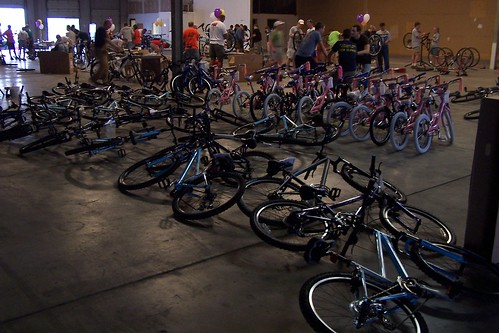
This is only a small portion of the bikes we assembled. All three hundred were assembled in a little under four hours. I was one tired puppy when we finished!


Local cycling personality and perpetual office-seeker Paul Tay, with Chuck Davis, owner of Oklahoma Velo Sports, and Gary Parker.

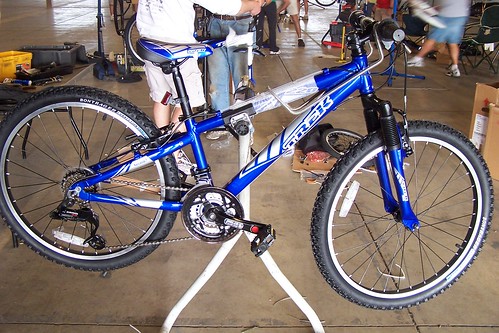
Nice bike, eh?

(CycleDog photo. See Flickr for the full set.)


Ren asked for thoughts about yesterday's bike building event.


When I got home from work, I spent some frantic minutes putting my toolbox together. Right before an event like this something always goes missing. Last night, it was the Y tool. Someone who looks a lot like me manages to misplace tools with depressing frequency.


I asked Jordan to come along. He wanted to borrow the car and go to church. Since I was using it, he couldn't. But he readily agreed to help out with building bikes. As it turned out, I glad he did.


We arrived at the warehouse in a pouring rain, hustled inside, and set up the work stand. Within a few minutes, we began assembling a multi-speed Trek mountain bike. I cut away the zip ties, rubber bands, and paper wrapping while Jordan removed small parts from the box and got the front wheel ready. A spot of grease went onto the seat post and it went into the frame, then the whole assembly went up into the stand. Jordan installed the pedals with a long 15mm combination wrench. I installed the handlebar and adjusted the front brake. I checked the derailleurs and the rear brake, and then the bike went down onto the floor. We tightened the pedals firmly and inflated the tires. Jordan rode the bike over to the storage area, then returned with another unassembled one.


That was the sequence we followed during the four hours it took to assemble 300 bikes.


Jordan said we did eight bikes but I didn't keep count. These Treks arrived in good condition. That is, there's little to do other than put them together and adjust the front brake after the cable is installed. I adjusted just one rear derailleur and encountered one bike with a brake problem I couldn't fix with the tools available. It had a burr inside one of its cable ferrules that caused the brake to stick. A few passes with a needle file would have fixed it, but my needle files were safely tucked away in my tool box at work.


Richard Hall arrived and set up his work station next to mine. We shared some tools. I had to show him a couple of antiques out of my tool box – an ancient Campagnolo T wrench and an equally ancient Campy 'peanut butter' wrench. He got a kick from the sticker on the back that says, “One wrench to rule them all and in the darkness bind them.” The funny thing is – whenever I slide that 15mm box end over my finger, I become invisible. What's up with that?


There was one minor annoyance when another mechanic began working just a few feet behind me, leaving little space for Jordan and I to work without bumping into him. Now, the warehouse is roughly 100,000 square feet. There's no reason to set up in close proximity to another person, particularly when that person is using a utility knife (as Jordan was) for opening boxes. Every now and then, I threw something over my shoulder. Yeah, it was wrong, but...

Wednesday, April 16, 2008

A near miss...


The lunatic is in my head

You raise the blade

You make the change

You rearrange me 'till I'm sane....Pink Floyd “The Dark Side of the Moon”


1996


The first thing I remember is lying on the gurney. A nurse said I could go home. She ordered a wheelchair to take me out to the car, but when I stood up, the room went white. Voices seemed to come from farther and farther away.


The next thing I remember is being wheeled into a hospital room. Mary said I had a seizure in the ER, so they wanted to keep me overnight for observation.


Hours earlier, I'd left work on my bike, riding north on Mingo Road. It was July 2nd, a nice summer day. I had my new Giant CFR, a bike I normally didn't ride to work since it didn't have a rack or fenders, but on a gorgeous day like that I wanted the 'go fast' bike. I had less than 600 miles on it.


The following came from eye witnesses and police reports. I have no memory of these events.


Just south of 76th Street, a car bumper hit my back wheel, went through the seat stay, and hit my left leg. The passenger side mirror hit my leg too. Witnesses said that I never let go of the handlebar as the bike and I rolled over. I hit the pavement with my head and right shoulder and rolled diagonally across my back and onto my left hip. My helmet was flattened on the right side. I had a concussion, extensive road rash, and a broken left leg. Owasso police and paramedics were there in a few minutes. They transported me by ambulance to a landing zone, where a Lifeflight helicopter took me to the hospital.


The driver who'd hit me was a real stand-up kind of guy. He tried to convince the police that his girlfriend was driving. Of course, he didn't have a license or insurance. His car had an expired tag and was worth less than my bike. I'm sure he would have fled from the scene except for the witnesses. Eventually, he would plead guilty to three offenses and pay a $750 fine. This may have been the third or fourth time he buzzed by very close, as I have a vague memory of a similar dark-colored car doing this in the days before the crash. There's no way to know for certain.


After my overnight hospital stay, I went home with a pair of crutches and a cast. Let me say this about concussions – they're not entirely bad because they make watching daytime television more enjoyable. Folding laundry was fascinating too. All my highs and lows were gone. I didn't get excited. I didn't get depressed, and I had the patience of a Buddha. My doctor warned that there could be lasting effects, and for a while I had difficulty reading aloud, following conversations, or writing without transposing letters. How much of this was due to the impact and how much was merely my increased awareness of everyday mistakes is something I'm unable to determine.


When the cast and crutches were gone, I started hobbling along the sidewalk with the aid of a cane. I met my kids coming home from school and walked a little bit farther every day. Months later, I was back on the bike, commuting to work.


If there's a lesson here, it's this – we can influence people without ever exchanging a word. All those parents and teachers around the school watched my slow recovery. Some thought I'd never get on a bike again, so they were astonished when I showed up on my commuter one afternoon and every afternoon thereafter. Months later, one of them told me that he'd thought to himself, “If he can do it, I can do it.”


One final thing. Susan asked for “close calls” stories. This one is more accurately a near miss, as in 'he nearly missed me'. Statistically, getting hit from behind is fairly rare. Just my luck.


Friday, March 28, 2008

INCOG BAG meeting

INCOG BAG Meeting


(This will be posted to NewOBC, CycleDog, TAOBIKE blog, and the Tulsa Now forum later today.)


25MAR2008 5:30P


Josh, Lisa, Tom, Patrick, Brian, Gary, Me...Monica arrived later


The original bicycling subcommittee had an organizational document describing their purpose. Do we have a similar document describing our goals and mission statement? We are attempting to locate the original. (Found a draft of the original on Wednesday, 26MAR, and it's been distributed.)


This committee represents an opportunity for a fresh start. This is not an official subcommittee of INCOG per Patrick.


We are the cyclist's voice, but do we have a role in planning?


We are to be proactive. Of local enhancement projects, 8 of 20 are funded. Public Works establishes a priority list. We want to bump projects up the list. For instance, the Mingo Valley Trail has been funded and that lead to neglect of other trail projects as money flowed to Mingo Trail. Patrick – we need signage and road markings and that money can go much farther than trails, increasing visibility of cyclist and cycling.


The Delaware bike lane was a joint effort of TU and Public Works.


Tom – we need to put ourselves forward as experts. Bicyclists need smooth streets, signage, and signals that react to their presence. City of Tulsa has a roadway design specification manual drawn from a variety of sources including ODOT and AASHTO. Can we get copies of this? Can we get copies of the AASHTO manual? One advantage of a regional Comprehensive Bicycle Master Plan is that it provides consistency from one municipality to the next. The rules and designs do not change as you cross from one jurisdiction to the next. INCOG has a facilities plan and a Master Trails Plan, but not a Comprehensive Bicycle Master Plan. City of Tulsa is motivated to pursue bicycle related projects, but regionally is questionable.


BAG needs to develop a document supporting the use of enhancement funds to hire a consultant for Comprehensive Bicycle Master Plan. Could Street Smarts be included as part of the master plan? It would include all the LAB E's: Education, engineering, enforcement, encouragement, equality, ...I forget the rest!


P. fox proposes committees to (1) become proactive in priority capital projects and funding of enhancement projects, and (2) improve on the current encouragement programs like BTW, trip tracker. Needs corporate help with promotion re: wellness, green issues, funding for radio, TV, newspaper ads. INCOG is promoting Ecology and Environment with Green Traveler program, ride share, mileage tracker. Summary page gives monthly totals and other information. Monica pointed out that unless corporations have a person tasked to collect the data, it falls through the cracks. We need to promote via other venues, Sustainability Tulsa, Wellness, Typros, health agencies, greens.


Monica - What are the benefits of logging all that information? Unless a company designates someone to compile it, the data will be lost.


Josh brought up the bike bus concept, an idea that deserves more promotion. Link up via Green Traveler?


Could we develop a new Corporate Challenge – pitting companies against each other for numbers of employees using bicycles for commuting and their mileage? We could publish a monthly list of winners in newspaper.


Safe Routes to School. Owen Elementary received funding from the state for projects. 100% of students live within 1.5 miles and there is no bus service. Lots of car traffic as a result. Intent is to promote kids walking and bicycling to school. Of $200K capital projects money, $20K goes to encouragement. PFox local coordinator for the project.


Community Cycling Project – money is available, yet no contacts have been made.


Open house on rail projects, 24APR. Where? Rail blog on line. GET URL


PFox needs help with: Enhancements and Bike to Work.


I agreed to help with writing BAG documents and whatever else need verbiage churned out. (More dummy me.)