
I read this yesterday on Austin Cycling News and it links to the original post on Bike Forums. ChezJfrey covered each point, refuting them one by one. His Bike Forum post is quite long, so I didn't include it here. Believe me, it's worth reading and well worth keeping for those inevitable letters to the editor that crop up in the spring and summer.
I sent the link to our local advocacy list and Gary Parker responded. His piece follows the highlights from ChezJfrey.
(Excerpts)
Look at some of the “arguments” presented by motorists in these types of “discussions” about why cyclists die:
1. “…he [/she] was probably one of those jerks that ride in the street.” and “Highways and roads are for motorized vehicles only.” and “Cyclists block the road.”
2. “All I am saying is if you do something dangerous (jump out of an airplane, ride my bike in the road where big cars are) then you should accept the consequences.” and “You ride on the street, you risk your life, simple as that.”
3. “Motorists have paid for the roads through gas taxes, registration fees, and other taxes and fees. Cyclists in traffic are a danger and seem to feel they have a right. Let them start registering and paying for road permits so lanes can be built for them. Streets are for cars.”
4. “It is very simple, give them a license plate, and they will be forced to abide by the law, or face tickets and fines.” “Cyclists do not have the same accountability as drivers. If you drive a car like a complete moron people can call and report you, and it is possible you will pay the price later on, can the same be said for cyclists?”
5. “It is illegal for bicyclists to run stop signs and signals; it’s illegal for them to swerve in and out of traffic; but that doesn’t stop them from doing it.”
6. “Why is it necessary to ride on the busy streets downtown when you can go 2 blocks in either direction and ride on a smaller side street without all the cars?”
The matter really goes right back to the fact that the average, urban/suburban driver just doesn’t want ANYONE in their way when THEY are on the road. Any deviation from the “zoom, zoom” fantasy that requires an extra turn of the wheel or a push on the brake pedal before the trip is through aggravates and irritates the motorist. The stupidity lies in the fact that these motorists encounter thousands of other motorists clogging the streets and crushing their dreams every day and the occasional, skinny bicyclist is to blame for the entire mess and that goddamn cyclist has a death wish about to come true!
Stupid people don’t embrace education, so that approach is doomed to failure.
(I don't agree that education is futile because we know that other two legs of the advocacy triad, engineering and enforcement, are insufficient by themselves in changing individual behavior. But that's a subject for another time......Ed)
This is from Gary:
Bicycling and Taxes
With gas prices, temperatures and tempers rising, bikes and cars seem to be coming into greater conflict.
A common complaint by motorists is bikes aren't registered or taxed, and should have no right to the road.
Our friends at the Texas Bicycle Coalition figured out that bicyclists are actually subsidizing motorists.
Follow this:
- 95% of cycling adults own automobiles, and they pay registration and fuel taxes, for an average of $700 a year per car.
- It costs cities and counties over $1100 per vehicle per year to maintain streets and roads.
- The extra $400 comes from the government's general funds, which are sales, property and income taxes.
These taxes are paid by everyone, including the 5% of cyclists who don't own cars. Even renters indirectly pay property taxes.
Given that most of us drive our cars more miles per year than we ride our bikes, we're paying about 50 times more per mile traveled than a motorist.
In Oklahoma we pay about 35 cents a gallon in taxes on gasoline, a few cents less for diesel. That is not a sales tax. Even as the price of gas goes up, the tax remains the same. If road costs were truly reflected in the price of gas, we'd be paying over $6 a gallon for gas today.
So the next time you're confronted with the "taxes" issue as it relates to bicyclists on public roads, you've got the answer. They are taxpayers and even if they were not, they would still have access to public roads, because they are public roads.
Showing posts with label bicycling education. Show all posts
Showing posts with label bicycling education. Show all posts
Sunday, July 27, 2008


Wednesday, July 16, 2008
Trail Etiquette: a primer

(Image copyright Spencer Hill. Used by permission.)
OK, much of the above is facetious, but there are some serious points. Let's consider them:
2. Whenever approaching other trail users move to a single file line.
3. On a trail walk dogs to the right! Yes this is different than dog training, but that is because when you walk a dog on the streets since you are on the left the traffic is on the right and you don't want little Fluffy running in front of a car. On a trail you walk on the right. You walk Fluffy on the right as well. You don't want Fluffy to run in front of a cyclist or a roller blader. Besides the land is on the right of the trail and Fluffy loves running along the ground.
I was running along the trail and this cyclist came by really fast and close without any warning.
This is probably the most common complaint – fast riders in 'stealth' mode. Cyclists should use a bell or loudly announce “Passing on your left!” as they approach pedestrians. Unfortunately, if a cyclist yells “On your left!” some pedestrians will turn and step to their left to see what's behind them, moving directly into a cyclist's intended path. Be aware that pedestrians can change direction or stop in the space of a single step.
For pedestrians – walk on the right and be aware of overtaking cyclists.
I was walking my dog, Fluffy, on a 20 foot long leash. It one of those retractable ones so I can keep control of Fluffy, yet allow her to romp a bit. She was on the other side of the trail when some cyclists started swearing at me for letting her roam like that. They could slow down and wait until she's done.
Children and dogs are often unpredictable. Be especially cautious when approaching them. Be prepared to brake or dodge, if necessary. Think of it as an opportunity to hone your mad cyclocross skillz. And please resist the impulse to skewer wayward dogs or their owners with a frame pump, halberd, or samurai sword. It's just not very polite.
For dog-walkers – while Fluffy may be utterly adorable, a 20 foot leash stretched across a multi use path is not. If a cyclist hits it at speed, there's a very good chance that he will crash. There's also a good chance that Fluffy could be injured. Be responsible for your pet and show some consideration for other trail users by keeping your animal on a short leash while on the trail.
Some deaf and blind guy was walking along the trail using his white cane for guidance when a cyclist yelled at him. Didn't do any good, that I could see.
While this is an obvious exaggeration, there are some pedestrians who simply will not see or hear any cyclists around them. Never assume a walker has seen you or knows of your presence, even if you're approaching them from the front. With so many people listening to music via headphones, it's a near-certainty that you'll encounter someone completely oblivious to all those other people on the trail.
For cyclists – wearing headphones in traffic is dangerous and illegal. Being safe on the road entails using all your senses, and that's no less true on the trails. Do not wear headphones.
My wife and I were showing her mom and dad the lovely River Park trail. We walked side-by-side in order to talk to one another and we were in mid- conversation when some cyclist yelled, “On your left!” Well, we looked over to our left but there was nothing to see. He yelled again, then went off the trail into the grass to go around us. When he got back onto the pavement, he yelled something about getting your fat ass over. I don't know why he'd pick on my mother-in-law that way. Her ass isn't that fat.
“On your left” is the standard way of announcing you're about to overtake and pass another cyclist. Unfortunately, some pedestrians hear this and will step to the left and turn around to see who or what is behind them. They step directly into the path of a cyclist. As noted above, say “Passing on your left” as a better way to make your intent known.
A better alternative is to yell, “Passing!” Most, though not all, peds understand what this means. Some cyclists use a bell as a warning device, but bells are no longer required by Tulsa ordinances.
For pedestrians – use the trail sensibly. If you're walking in a group, allow some space to the left for others to pass. Taking the full width of the trail is rude and irresponsible.
My friends and I were skating on the trail, just bopping along and listening to some tunes on our iPods, when a bunch of cyclists passed us really close. They never said a word – not that we could have heard them anyway.
Passing skaters on a narrow trail is difficult. Their zig-zag course can make it hard to predict when it's safe to pass. Just like children, the elderly, dogs, or people with diminished mental capacity, skaters are capable of suddenly moving into the path of a cyclist and causing a crash. Be wary when approaching them.
For skaters – turn down the tunes so you can hear others around you, and be prepared to coast for a moment while a cyclist passes. It's both courteous and safe – for both of you.
I have a suggestion that may improve relations between cyclists and pedestrians on crowded trails. We need bigger pedestrians so there's no mismatch in energy. Kinetic energy is equal to the product of mass and velocity squared, so if a 200 lb bicycle and rider moving at 10 mph were to collide with a 550 pound pedestrian moving at 6 mph, they'll have approximately the same KE. The only problem I can see is in finding a 550 pound pedestrian capable of moving at 6 mph. Maybe if we could get two 225 pound pedestrians to move in lockstep...
Ah,a phalanx of pedestrians moving as a unit. Give them some brass instruments, drums, and snappy uniforms, and we'd have a marching band. Better yet, give them kilts and bag pipes. Nobody messes with guys in skirts playing the pipes.
OK, much of the above is facetious, but there are some serious points. Let's consider them:
(Gary added some points I missed)
2. Whenever approaching other trail users move to a single file line.
3. On a trail walk dogs to the right! Yes this is different than dog training, but that is because when you walk a dog on the streets since you are on the left the traffic is on the right and you don't want little Fluffy running in front of a car. On a trail you walk on the right. You walk Fluffy on the right as well. You don't want Fluffy to run in front of a cyclist or a roller blader. Besides the land is on the right of the trail and Fluffy loves running along the ground.
Speed
Riding on trails is the same as riding on a sidewalk and on sidewalks cyclists must yield to pedestrians. Tulsa's River Park trails have a suggested speed limit of 10 mph. Any reasonably fit cyclist can exceed this, of course, so be courteous and safety minded when overtaking peds. Please be courteous, and stay particularly alert if there are children or pets nearby.
Awareness
For pedestrians - there's more to this than simply unplugging the iPod or turning off the cell phone. It's a basic safety issue whenever we're out in public. Be aware of your surroundings. Be alert for the unexpected. Be alert for suspicious people or objects. This isn't an attempt to make you paranoid, just wary. Criminals exploit people who aren't paying attention or are otherwise distracted. Likewise, in a traffic mix with people moving at different speeds, it pays to stay alert.
For cyclists – make others aware of your presence and intention of passing. Use a bell, or shout, “Passing on your left!” Just as pedestrians have to be aware of overtaking cyclists, cyclists themselves have to be aware of other bicyclists moving at higher speeds. Watch your six.
Consideration
Trails are shared public spaces that belong to all of us. Please don't leave trash behind. Treat other trail users as you would wish to be treated.
And finally...
Since I'm not all-wise and all-knowing, I probably missed a few things. Please feel free to point out my deficiencies in comments!
Thursday, June 26, 2008
Aren't you happy to get here safely?
I'm on the road at the same time and on the same route every morning. I see the same motorists day after day.
I know when the Crotch Rocket Kids are coming because their motorcycles have a distinctive high-pitched whine. These two guys ride to work together every day. They're normally in echelon and I think that's probably a good idea on a relatively narrow road.
There's Dinky Boy in an econo-box that sounds as if it's powered by a lawn mower engine. The car seems to be taller than it is long.
I saw Scooter Guy most mornings last summer, but I heard he was involved in a crash with another motor vehicle, and I haven't seen him since. When I arrived at work that morning, some co-workers were waiting out front to see if I was on the bike. They'd heard about the crash north of the base and were concerned that I was involved. I suspect there may have been some betting going on. I liked chasing Scooter Guy when I had a tailwind.
Black Helmet Guy rides a Harley. It makes the usual thumpa-thumpa exhaust sound. Fortunately, the bike is still equipped with original mufflers so it's not terribly loud.
White Helmet Guy rides a quiet Harley too. But he's a dick. He's blasted by me very close while laying on the horn. There's a problem with daily commuting – especially when our hours are the same. I watched for him on my way home one afternoon, and then hooked him as he was passing. He reacted by going over into the on-coming lane. I could hear him yelling but I couldn't make out what he said. (For those who may not know, hooking is an illegal maneuver in bicycle racing. Normally, it's done during a sprint when a rider is trying to pass. The leading rider does a quick wobble that forces the overtaking one to slow or change his line. Hooking can easily result in a crash. I would imagine that hooking could be considered an illegal maneuver under our traffic laws too, but I've never heard of anyone being charged with it.)
I saw something this morning that was simply mind-boggling. As I approached 46th Street from the north, the light was green but I knew from long experience that I'd never get through it. The dump truck driver behind me, however, was undeterred by the prospect of the light changing. Sure enough, well before we reached the intersection, it turned yellow and then turned red. The dump truck never slowed. The light had been red for at least a second before he got to the stop line. He barreled on through. Cross traffic had quite sensibly remained stationary when their signal turned green. But the truly amazing thing was that the dump truck driver applied his brakes in the middle of the intersection, slowing as he exited it to the south, and then immediately turned left into a diner parking lot. He was willing to endanger several lives in order to save a minute or two in getting to those biscuits and gravy.
It wasn't over yet.
Cross traffic started moving. I waited for the light to change. More cars and trucks were queued behind me. The light changed, giving southbound traffic a green. Again, I looked on in amazement as traffic coming from my left didn't slow down. Five cars and trucks ran the light well after it had turned red.
An all-too-common complaint from motorists is that cyclists don't stop for red lights or stop signs. It's beginning to look as if motorists won't be bothered with them, either. There's a huge difference between a 250 pound vehicle and one weighing 2000 pounds or more when it comes to a collision.
While I locked up my bike at work, another co-worker was getting out of his car in an adjacent parking space. “Aren't you happy to get here safely some mornings?” he asked. I gave him my usual boilerplate answer – that I'm more concerned with dogs and skunks on the road than motorists, and that the most dangerous part of the ride is the trip across the parking lot. But after watching the mayhem at that intersection, I'm not so sure of these pat answers.
Later in the morning, I saw a letter from Jerry Rink in the Tulsa World. He complained about encountering a bicyclist doing '5 mph in the middle of the lane.' He yelled at him to get over and the cyclist informed Rink that he (the cyclist) had the right of way. Rink had the usual bitch about cyclists restricting traffic, but went on to say this:
“I'd have liked to run him aside if it weren't for the legal problems!”
I think there's clearly an implied threat. If Rink met a cyclist when there were no witnesses around, how could we expect him to react? Would he react as angrily to a tractor or a couple of motorcycles rolling along slowly? I'd suspect he would not, if only because a farm tractor could destroy his car, and annoying motorcyclists is a good way to acquire a large boot print in the door. Cyclists are fair game, however, because it's unlikely that we can catch him.
Motorists have a common assumption, sometimes called the universal law of speed, that presumes they can go as fast as they want to, whenever they want to, and that anything that causes them to slow down is inherently un-American, anti-social, and often times downright evil. Going slowly is a sin. Cyclists are big time sinners and their low speed causes other, presumably upright citizens to fall prey to the same lack of morality. Or some such bullshit.
A cyclist's relatively small size and obvious vulnerability makes harassment easy. I think that laws requiring a minimum of 3 feet minimum separation when passing a bicyclist is a good first step. South Carolina recently went further with 56-5-3445. It's a misdemeanor to harass, taunt, or maliciously throw an object at or in the direction of anyone on a bicycle. LINK (In Oklahoma, it's a felony to throw an object at a motor vehicle. No similar provisions apply to cyclists, however, since a bicycle is a “device” not a motor vehicle.)
An obvious question about these laws has to do with enforcement. In my experience, unless a police officer witnesses the offense, it's difficult or impossible to bring charges. That may be changing as more cyclists use small, unobtrusive video cameras like the Oregon Scientific ATC2K. I'm thinking about getting one, though not for pursuing scofflaw motorists.
Tulsa's Community Cycling Project

(Image from Urban Tulsa Weekly)
Urban Tulsa Weekly has a very complimentary article on the Community Cycling Project. Major kudos to both Sandra Crisp and Ren Barger. Here's a excerpt:
Two Wheels to Stand On
How a "bike kitchen" is helping the city's homeless get back on their feet
BY BRIAN ERVIN
Most of us have cars and, though they might not all be as sexy, sporty or as nice as the Joneses, they still afford us the independence we need to live our lives, go to work and stand on our own two feet (rising gas prices notwithstanding).
And, we tend to take that independence for granted most of the time, except when the inevitable wear and tear or a mechanical malfunction grounds us for a few days until the repair shop restores our autonomy.
For many of Tulsa's homeless, though, lack of transportation is all that stands between them and self-sufficiency.
"That's a big issue for the homeless," said Mack Haltom, associate director of Tulsa's Day Center for the Homeless, about the role of transportation in rehabilitation.
"There's plenty of work for folks, but city buses don't always get them where the jobs are," he added.
That's why Haltom and many of his colleagues sing the praises of the Tulsa Wheelmen bicycle club's Community Cycling Project.
"It meant the difference between working and not working, in many cases," said Gloria Dialectic, a Day Center caseworker.
As CCP coordinator Ren Barger explained, the program provides bicycles, including all the necessary equipment and a full day's worth of safety training, with an entire year's worth of service thrown in--all absolutely free of charge.
Prospective benefactors can contact Barger at ren@leesbikes.com.
(More)
Tuesday, May 20, 2008
Tulsa Tough Kid's Challenge
Skills and Drills Clinic
Sunday, 19MAY2008
This was the final skills and drills clinic for the Tulsa Tough Kids Challenge. The instructors were: Brian Potter, Ren Barger, Richard Hall, and myself. We had numerous volunteers assisting with registration, helmet and bike fitting, and even police officers from the Tulsa Police Department and the Tulsa County Sheriffs Office.
Jordan went along for this one too, and it's a good thing he did. Some of the kids in my group had ill-fitting helmets or bikes with minor mechanical problems that required immediate attention. Jordan stepped in for me and kept the drills rolling while I took care of the problems. He's easily approachable. Kids like him. He's a fine assistant to any instructor. And there's no denying he worked hard because he dehydrated badly like I did last week. Just know that I'm proud of him for helping so much on Sunday.
One mother asked if I had an operator's manual for teenage boys. It didn't dawn on me until Monday – when I began writing this – that she was commenting on my son! I had to say that if I could write something like that, I'd have a yacht or an island of my own. Apparently, Mary and I did something right as far as parenting is concerned, but for the life of me, I don't know what it was. “As the twig is bent...” A friend said that by the time they're 16 or 17, we're just along for the ride.
Would it be possible to invite some kids from this year's group to attend next year's 'classroom' events? Perhaps we could solicit teachers to have a writing contest or something similar in order to select the most persuasive kids to assist with our pitch. At their age, peer pressure can work to our advantage.
To that end, we need to keep an idea file for next year. I set a reminder in MS calendar.
We need some people to perform an effective gatekeeper function. Brian said to trust the registrars, but they were perhaps too lenient in allowing some to attend. We had one family show up with their daughter who'd been registered, along with her two younger brothers who most likely were not, but I had no way to verify this. I think they were no older than six and they were a pain-in-the-ass to deal with because they simply would not listen until I bellowed at them. Next year – turn away these very young kids outside our targeted age group. We need to turn away kids who are not dressed appropriately, re-scheduling them for a later session. I had one kid wearing flip-flops. There may have been more. That may be a PITA for the gatekeeper, but it makes our job easier. No one wants to be the bad guy, the one who says 'no' to anxious parents and kids, but it's a necessary function.
I think that we should plan out the classes differently, allowing more time between sessions although that would stretch out the day. The kids need to be rested and fed before class, so maybe schedule two classes at mid-day. Give the staff an hour break over dinner, and have an evening session.
The kids seemed more anxious, hyper, and whiny this time perhaps because it was later in the day. The warehouse was hot and I had a few who wanted to take breaks for water every few minutes. “How many minutes left?” one asked repeatedly. That last group probably hadn't had dinner either and that's sure to make kids cranky. It makes me cranky!
And finally, Ren said she had a temper tantrum due to being so irritated by some of the kids. That didn't really qualify as a temper tantrum. I use Conan the Barbarian as a model. "Kill your enemies! See them run before you! Hear the lamentations of their women!" Now, that's a tantrum! I really need to wear more furs. Where can I get a battle axe?
Sunday, May 11, 2008
Tulsa Tough Kids Challenge


This is from Gary Parker, one of the local LCIs and an ardent bicycling advocate. Gary taught at yesterday's Tough Kids event. He's a retired teacher, and in all honesty, he's probably forgotten more about teaching than I've ever learned. Both Gary and Ren Barger have that special touch that allows them to connect with kids. I always watch carefully when they're speaking to a group, hoping that I can learn more. My post follows Gary's.....Ed
Dear TaoBIKE Team,
Thank you for your wonderful effort on behalf of the kids participating in today's Tulsa Tough Kids Skills and Drills.
Brian Potter took the lead. The agenda arrived at earlier was very efficient. Four groups of about 20-plus kids moved through the activities quite efficiently. This was due in great part to teacher/coaches Richard Hall, Ren Barger, and Ed Wagner.
Ed's son Jordan participated providing examples of the skills assignments. Several of the Tulsa Bike Patrol were also on hand. Adam was there from the outset with some shop mechanics.
The sequence of events went very smoothly with greater skill for delivery of services being acquired with each successive group.
A special shout-out "Thank you!" to Brian joining me for my bike ride back to the River's Edge at 21st and Riverside.
From the three sessions of helmet fitting through riding in a straight line, stopping-starting and turn signaling, and a big finish with two by two riding of the entire group around the warehouse as they monitored their spacing and speed.
What a great day for Tulsa kids and Tulsa bicycling.
My appreciation to all of the folks that made today's Tulsa Tough Kids bike event such a wonderful happening.
Gary Parker
Jordan and I left early on Saturday morning for the Skills and Drills Clinic. The Tulsa Tough is giving away 300 Trek bicycles to local kids this year. We helped to assemble them and we participated in the classroom portions at several local schools. Jordan was especially valuable because as a teenager, he's closer to the elementary kids ages, and he's more approachable than an adult. I think he enjoyed the attention too.
The LCI cadre did an amalgam of Kids 1 and 2. We held the clinic in a warehouse this year, the same warehouse that we'd used for bike assembly. It offered some advantages since we didn't have to be concerned about the weather. But the floor was smooth finished concrete, so we had to adapt the drills for the reduced traction. Instant turns were out, as well as the rock dodge. That proved to be a good call because some of the kids showed poor bike handling skills on the serpentine course, and naturally, some were overly aggressive. Fortunately, no one fell and we didn't have any collisions.
The first group was a the largest with about 75 kids. It was important to stay on message and keep track of time. Brian had allotted 15 minutes for each section, along with a 5 minute break at the mid-point. It was a challenge to keep the kids focused and get all of them through each drill several times so they could develop some proficiency. I talked with one parent and described it as “trying to herd cats.” For the most part, the kids were focused and attentive.
The Tulsa Police Department sent 5 officers from their bike patrol unit. These folks were wonderful! They helped with helmet fittings, stopping drills, and even acted as pedestrians at one point. I'm not sure if the kids paid more attention to the instructors or the guys in uniform, but there's no doubt in my mind that the police officers were very effective in a bicycling education role. (We talked briefly about the IPMBA and LAB's Road1, but that's a subject for another time.)
There were some heartbreakers too. One boy was worried because his mother wasn't there. “She never comes to anything with me,” he said. I could hear the hurt in his voice. One girl had broken her arm the previous weekend and was in a hand-to-shoulder cast. She very gamely wanted to participate, but we were worried that she wouldn't be able to control her bike and she could fall, re-injuring the arm. I had to tell her she was excused from the class. She had tears welling up in her eyes. At least she has a new bike even if she can't ride it yet.
We had a few kids with learning problems. They required more one-on-one instruction, and we worked with them as we could. But we had two kids who didn't know how to ride a bike at all. The parents were told at the classroom sessions that we did not have the time or staffing to teach beginners, yet they signed up to get that free bike anyway. Some parents gamed the system too. They arrived at the warehouse, received their helmets and bikes, and then disappeared as soon as possible. Perhaps they saw little value in the instruction, but in a perverse way it benefited the kids who stayed because we could spend more time with them individually.
Finally, a word about the volunteers. The LCI group didn't do this alone. The Tulsa Tough operates with a network of volunteers, people who donated their time to unload trucks, assemble bikes, handle administrative chores, and even take out the trash. It truly is a team effort because none of us could accomplish our tasks without the others. A well deserved thank you goes to St. Francis Hospital, the Tulsa Crime Commission, Adam Vanderburg (owner of Lee's Bicycles), and the hundreds of people who worked together to bring this event to area kids.
And we get to do it again next week!
Thursday, May 8, 2008
Nitrogen?

Local television news has a story about filling car tires with 100% nitrogen. Allegedly, nitrogen doesn't leak down as quickly so tires stay at a higher pressure for a longer period of time. This increases gas mileage. There's also a claim that nitrogen extends the life of the tire, but I suspect that if they're properly inflated – regardless of the gases inside them – they'll last longer too.
For a fleet operation, filling tires with nitrogen probably makes sense. If the claimed 3% increase in gas mileage is true, it translates into large cash savings. But the local business offering this service charges $39.95 to fill four tires. From where I sit, that may not be a cost-effective savings for consumers.
There's a solution, of course. I use a cheaper mixture that contains only 80% nitrogen in both car tires and bicycle tires. The only drawback is that I have to check the pressure regularly. That means using a pressure gauge on the car tires about once a week. But for a bicycle, the pressure has to be checked before every ride.

That brings us to the ABC Quick check. (You didn't think I'd skip a BikeEd moment, did you?) A is for air. Check your tire pressure before every ride. Yes, it reduces rolling resistance, but it also reduces the chance of a pinch flat. Spin you wheels and look for tire cuts or a rim wobble that could indicate a loose or broken spoke. B is for brakes. Squeeze the brake lever and ensure that there's a fingers width of space between the lever and the handlebar. C is for the crank and chain. Try to move the crank arms in and out, feeling for any looseness. Feel for a loose pedal, and see that the chain is in place. Q is for quick releases. Get in the habit of putting them in the same position all the time so you can tell at a glance if they've been moved. Returning to C a moment, when you first start out pedal gently to ensure that the chain is in place properly and no one has tampered with your derailleur levers, particularly if the bike was parked outside in a public place.
There are some costs associated with ignoring the ABC Quick check. Once, someone who looks remarkably like me fixed a flat tire, then pushed off down a hill. I...er...he hadn't closed the brake release lever, so the caliper barely touched the rim. Naturally, the lever went all the way to the handlebar and he discovered the brake was pitifully ineffective. Doing the ABC Quick check would have prevented this mishap.
Another time, this same rider had a rear quick release partly open. The wheel was installed in an old frame with horizontal frame ends. When he stood to power away from a stop light, the wheel popped out and tacoed. While it's possible to straighten a wheel by supporting it on a curb and forcing the rim back into alignment, it's not a practice I recommend. Some of the neighborhood kids learned a wide variety of new and exciting words that day.
(Snark alert)
Here's a fitness idea that would also save money for big fleet operators, like cities that have a large number of police cars – get cops to check their air pressure at the beginning of each shift, and give them a bicycle pump for inflation. It's a win-win situation! Proper tire inflation leads to improved gas mileage and increased tire life. And as a side benefit, we get physically fit police officers with fewer health problems. (Except for TCSO who would need extensive training in how to use a bicycle pump in the first place.) As a taxpayer, I'm 100% behind this idea!
Wednesday, May 7, 2008
We need a new tool...
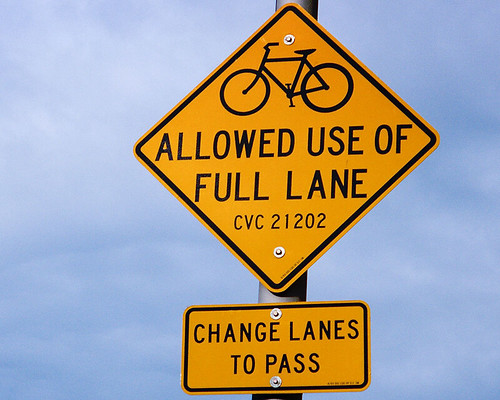
We know that 'fear from the rear' is irrational and it drives much of the facilities advocacy. But today I'm not addressing the institutional problems of dealing with traffic engineers, bureaucrats, and planners. Instead, I'm looking at the reduction of irrational fear on an individual basis.
Most of us with long experience seldom fear riding in traffic, and when we meet someone wholly consumed by that irrational fear we may have difficulty understanding it. I know I do at times. Our first response is to say that the fear is unfounded or greatly exaggerated, but this does nothing to reduce it. We can offer facts and statistics, yet they're all ignored. That's the definition of 'irrational' - something that defies reason and logic.
Think of watching a horror movie in a theater, for example. Objectively, we know that it's nothing more than sound and flashing lights in a darkened room. Yet the fear it induces is real - at least until the house lights come up.
My industry used to offer Fear of Flying classes for potential customers. Again, we know that flying is a very safe means of transportation, but simply telling a fearful person that isn't sufficient. The company offered classes that gradually habituated these customers through a succession of experiences that eventually led to taking a flight. It worked on two levels, the rational and the emotional.
That emotional approach is one we should discuss. Our opposition has met with considerable success by using fear as a tool. Is there an equally powerful one we could use? (Of the seven deadly sins, I could only remember gluttony, sloth, and avarice, and they're not really suitable, though I'm well acquainted with the first two.) Demonstrating vehicular cycling techniques is a real eye-opener but it works best one-on-one. We need something with the emotional impact of 'fear from the rear' that will let us reach a broader audience. I suspect that if we can influence large groups of individual cyclists, the institutional problems offered by traffic engineers, bureaucrats, and planners will simply go away.
Wednesday, April 30, 2008
Riding Two Abreast

A discussion of state and local laws that pertain to bicycling is a standard part of any Road1 course. As part of the bicycling education effort here on TAObike, this may become a regular feature. Brian Potter and I were specifically asked about the 'riding abreast' portion of Oklahoma's bicycling law, and we solicited Gary Parker's input for this post also. Now remember, none of us are attorneys. We merely watch them on television until they get boring. We're League of American Bicyclists instructors, and as such we teach 'best practices' that conform to the law.
There's a great deal of confusion and misinformation regarding bicycle law in Oklahoma. Partly, that can be attributed to the fact that state law and local law may differ on some points. But on riding abreast, both Oklahoma and Tulsa law agree that it's a legal practice.
As in every discussion of our legal rights, there's also the counter balance of responsibilities. The two go hand-in-hand.
(OKLAHOMA)
§47-11-1205.
[b]Persons riding bicycles upon a roadway shall not ride more than two abreast except on paths or parts of roadways set aside for the exclusive use of bicycles.
(TULSA)
SECTION 1006. RIDING ABREAST
Persons operating bicycles upon a roadway shall not ride more than two abreast, except on paths or parts of roadways set aside for the exclusive use of bicycles.
This is unambiguous language prohibiting cyclists from riding more than 2 abreast. Some misread this and interpret it as a prohibition against riding 2 abreast, forgetting that it actually says “more than 2 abreast” provided the riders are on a roadway. Strangely, this law allows more than two abreast riding on paths or parts of roadways set aside for the exclusive use of bicycles. So it would be legal (but rude and perhaps dangerous) to ride three abreast on the River Park trail, for instance. Keep three abreast in mind because we'll return to it momentarily.
But why would cyclists want to ride side-by-side? Wouldn't single file be safer, not to mention more convenient for motorists? I'll preface this by stating that as far as I'm aware, there are no crash statistics available that show rates for single-file vs two abreast riders.
First, here's a brief explanation of lane positioning and Oklahoma's three feet law. Again, these are worthy of detailed discussion, so this will be merely an overview. Cyclists should ride in the right-hand tire track. This means they have a third of the lane to their right and two-thirds to their left. Most lanes in Oklahoma are 12 feet wide, so a cyclist would have 8 feet to his left (from his tire track or the center line of his bike) out to the center line on the road. A bicycle is approximately 2 feet wide, so if his tire track is 3 feet from the right hand road edge, the left side of this handlebar is 4 feet from that edge. Overtaking traffic must give a cyclist 3 feet of clearance at a minimum, so a single cyclist takes up 7 feet of road width. That leaves 5 feet of usable width for overtaking. If a motorist wishes to pass safely and legally, he must straddle or cross the centerline when opposing traffic permits. Make no mistake – it is ALWAYS the responsibility of overtaking traffic to do so safely. So in a typical Oklahoma lane, a motorist must cross the centerline in order to pass safely whether there is one cyclist on the road ahead or two cyclists riding side-by-side. The passing situation does not change with the number of cyclists present.
To some it will seem counter-intuitive, but riding side-by-side benefits both motorists and cyclists. Two cyclists are more visible to an overtaking motorist, so it's more likely he'll slow down and pass safely. And if a group rides 2 abreast, its total length is halved. Six cyclists occupy as much space as a single motor vehicle when they're side-by-side, meaning that an overtaking vehicle spends less time in the opposing lane. What some motorists see as an unnecessary obstruction actually makes the road safer for both cyclists and motorists.
But what of those situations where cyclists are riding 3 or more abreast on the road? While it may appear to be illegal from a motorist's perspective, what may be happening is a lone cyclist is passing two others. Speed differences are often only 2 or 3 miles per hour, so passing can take some time and distance. Most cyclists realize that if they're caught up in a large group riding 3 wide or more (as is common in bicycle racing) the cyclist in the middle has nowhere to go if something happens just ahead. Even a casual observer at a race can see the chain reaction in a big group as a single rider causes many others to fall. For that reason alone, riding three or more abreast can be very dangerous and is deservedly illegal.
Thursday, April 24, 2008
Tulsa Tough Kids Challenge: the bike build
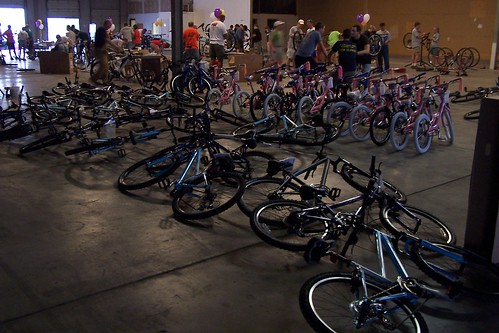
This is only a small portion of the bikes we assembled. All three hundred were assembled in a little under four hours. I was one tired puppy when we finished!

Local cycling personality and perpetual office-seeker Paul Tay, with Chuck Davis, owner of Oklahoma Velo Sports, and Gary Parker.
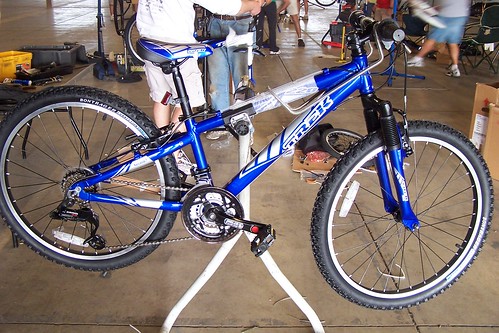 Nice bike, eh?
(CycleDog photo. See Flickr for the full set.)
Ren asked for thoughts about yesterday's bike building event.
When I got home from work, I spent some frantic minutes putting my toolbox together. Right before an event like this something always goes missing. Last night, it was the Y tool. Someone who looks a lot like me manages to misplace tools with depressing frequency.
I asked Jordan to come along. He wanted to borrow the car and go to church. Since I was using it, he couldn't. But he readily agreed to help out with building bikes. As it turned out, I glad he did.
We arrived at the warehouse in a pouring rain, hustled inside, and set up the work stand. Within a few minutes, we began assembling a multi-speed Trek mountain bike. I cut away the zip ties, rubber bands, and paper wrapping while Jordan removed small parts from the box and got the front wheel ready. A spot of grease went onto the seat post and it went into the frame, then the whole assembly went up into the stand. Jordan installed the pedals with a long 15mm combination wrench. I installed the handlebar and adjusted the front brake. I checked the derailleurs and the rear brake, and then the bike went down onto the floor. We tightened the pedals firmly and inflated the tires. Jordan rode the bike over to the storage area, then returned with another unassembled one.
That was the sequence we followed during the four hours it took to assemble 300 bikes.
Jordan said we did eight bikes but I didn't keep count. These Treks arrived in good condition. That is, there's little to do other than put them together and adjust the front brake after the cable is installed. I adjusted just one rear derailleur and encountered one bike with a brake problem I couldn't fix with the tools available. It had a burr inside one of its cable ferrules that caused the brake to stick. A few passes with a needle file would have fixed it, but my needle files were safely tucked away in my tool box at work.
Richard Hall arrived and set up his work station next to mine. We shared some tools. I had to show him a couple of antiques out of my tool box – an ancient Campagnolo T wrench and an equally ancient Campy 'peanut butter' wrench. He got a kick from the sticker on the back that says, “One wrench to rule them all and in the darkness bind them.” The funny thing is – whenever I slide that 15mm box end over my finger, I become invisible. What's up with that?
There was one minor annoyance when another mechanic began working just a few feet behind me, leaving little space for Jordan and I to work without bumping into him. Now, the warehouse is roughly 100,000 square feet. There's no reason to set up in close proximity to another person, particularly when that person is using a utility knife (as Jordan was) for opening boxes. Every now and then, I threw something over my shoulder. Yeah, it was wrong, but...
Wednesday, April 23, 2008
Tulsa Tough Kids...
Kids1 Presentations
Monday and Tuesday evenings, the Tulsa LCI group did Kids1 presentations at Webster High School and Carver Middle School in Tulsa. Actually, we're offering an amalgam of Kids1 and Kids2 in the League of American Bicyclists curriculum because the kids who attend these events will receive new bicycles through the Tulsa Tough program. We want them to be prepared to ride safely.
The LCI group consists of Ren Barger, Gary Parker, Brian Potter, and me for these events. We followed the Crime Commission's “Safe Escape” program which teaches kids how to avoid abduction. Safe Escape is a free presentation they offer to any interested organizations in the Tulsa area, and to be blunt, it's a tough act to follow. We're bland and boring by comparison.
Watching Gary and Ren work with the kids is always enjoyable. They both have the light touch that develops almost instant rapport. Brian does the 'expert instructor' role, and I provide comedy relief. I'm lucky to have straight guys like these.
We watched 'A Child's Eye View' which is a short video on cycling safety produced by LAB. Gary asks the kids to watch for the mistakes the kids in the video make, and they're on it like hawks. He doesn't tell them what to look for – he merely asks, “What did you see?” The kids don't miss much. They tell us of a kid riding on the wrong side of the road, running stops signs, riding without a helmet, and riding out onto the street without scanning for traffic first. Honestly, they didn't miss a single mistake.
I was lucky to have Jordan along on Monday evening. On the drive to Webster, I told him to expect a question about how taking Road1 and learning the rules of the road helped him when he took his driver's license test. Brian called on him during the lecture and Jordan responded very well. Afterward, six or eight kids gathered around to ask him more questions. The LCIs are impossibly old by kids standards, but Jordan is closer to their age and easily approachable. I think he was a bit surprised by the attention.
Today (Wednesday) we get to assemble those new bikes – all 300 of them. Last year, we had an enormous group of mechanics, box haulers, pizza technicians, and other support people. The team assembled 200 bikes in about 90 minutes. I'm hoping it goes as quickly tonight.
In May, we'll do the skills and drills portion and the kids will get their new bikes and helmets. That will be intense because we'll have 3 classes each day. After that, there's a planning meeting for the tech support staff, and the two-day Tulsa Tough event itself. I've been having short nights and long days already, and I'm only peripherally involved in the Tough. Those more centrally involved must be working their butts off!
So if you participate in any of these big events, whether it's a local charity ride or a big racing weekend, take a moment to thank the volunteers. And don't be surprised if you find one of us fast asleep in a chair during a quiet moment.
Saturday, April 19, 2008
Tulsa Tough Kids Events
.
.

The first of the Tulsa Tough Kids Challenge events will kick off on Monday, April 21st.
Tulsa Tough Children’s Hospital Tough Kid’s Challenge
The Children’s Hospital at Saint Francis has once again provided the opportunity for kids to win a free bike, helmet and t-shirt through Tulsa Tough. This year 3rd, 4th and 5th grade-aged children are eligible for the program. To receive the bike children must complete a Safe-Escape class conducted by the Crime Commission along with a bicycle handling skills class conducted by the League of American Bicyclists. Kids will then pick up their bikes at the Skills and Drills class and are required to participate in a Tulsa Townie ride on Sunday June 1st at Tulsa Tough. All kids events are free. Parents are encouraged to ride with their kids by signing up for the Townie ride.
Register online at www.tulsatough.com or call the Crime Commission at (918) 585-5209.
.

The first of the Tulsa Tough Kids Challenge events will kick off on Monday, April 21st.
Tulsa Tough Children’s Hospital Tough Kid’s Challenge
The Children’s Hospital at Saint Francis has once again provided the opportunity for kids to win a free bike, helmet and t-shirt through Tulsa Tough. This year 3rd, 4th and 5th grade-aged children are eligible for the program. To receive the bike children must complete a Safe-Escape class conducted by the Crime Commission along with a bicycle handling skills class conducted by the League of American Bicyclists. Kids will then pick up their bikes at the Skills and Drills class and are required to participate in a Tulsa Townie ride on Sunday June 1st at Tulsa Tough. All kids events are free. Parents are encouraged to ride with their kids by signing up for the Townie ride.
Register online at www.tulsatough.com or call the Crime Commission at (918) 585-5209.
Monday, March 31, 2008
Take the lane (Revised)
 By Brian P and Ed W...
One of the primary concepts in BikeEd is lane-positioning. A cyclist should always maintain a safe distance from the gutter pan or parked cars, a minimum of 3 to 4 feet. And motorists in Oklahoma are required to provide at least 3' passing distance when overtaking a cyclist. A little math tells us that if we add 3 feet from the gutter pan, 2 feet for the cyclist, and 3 feet for the minimum safe passing distance, we get 8 feet. Most cars are at least 6 feet wide. Therefore, a shareable lane can be no narrower than 14 feet. Keep in mind that in Oklahoma, lanes are rarely wider than 12 feet. That's where defensive lane-positioning comes in.
(Image from Bicycling is Better, with an excellent discussion of lane positioning.)
"Taking the lane" increases safety and visibility. Both new and experienced cyclists are often reluctant to try this. It seems counter-intuitive that by moving further to the left, one decreases the risk of collision, but when cyclists try the technique, they're astonished to discover how effective it is. Lane positioning communicates whether it's safe to pass or not. When a cyclist is in the middle of a narrow lane, he's telling drivers behind him that there isn't sufficient space to share the lane side-by-side, and that they'll have to yield to traffic in the adjacent lane before overtaking. When the cyclist moves further to the right, he's indicating it's safe to overtake. A cyclist should NEVER ride too far right (i.e., hugging the fog line, the curb, or even the gutter pan) because it invites motorists to 'sgueeze by' in the lane regardless of safety. On a 2-lane road, the passing motorist might be forced to choose between a head-on collision or running over a cyclist. In short, improper lane-position is a good way to get squeezed off the road.
Earlier today I read a comment by 'Siouxgeonz" on "Commute by Bike" about her introduction to lane-positioning. (Her own blog is "Urbana-Champaign Bicycle Commute".) Here's what she had to say:
I was reluctant to claim the lane at first, in a huge part because so many of the people who wrote to say it was the right thing to do seemed to emphasize "making a statement," and I so much don't want to make a statement that people can talk about in my eulogy...Now, I cringe whenever I hear somebody say "but I worry about the one who doesn't see me" and hugs the line, because so many more people *don't* see you when you're doing that. It's a perceptual thingŠ
I, too, learned to take my lane with a baptism in fire on a busy road...Two of us were riding and my friend noted that the drivers were buzzing by awfully closelyŠ which (my silly verbal mind; it takes words to make anything happen) made me think "oh, yea! I've read that if we move outŠ" so we did.
Danged if suddenly the drivers didn't get a whole lot better at giving us room! Instant education! And we weren't dead center; just crossing into that "you're in the car part" threshold.
We stopped for a bite to eat, and when we started riding again, the drivers forgot how to pass us again. Oops, make that we were too far to the right, because as soon as we nudged out againŠ the drivers got better. Amazing how educable they are! (Used by permission of Siouxgenoz.)
Some cyclists think that it's rude or arrogant to take the lane. Some think the practice antagonizes motorists unnecessarily. My response to that it is simple. Safety always trumps convenience. Nothing in the law requires anyone on the road to do something they know is unsafe, and hugging the fog line or gutter is definitely not safe. Yes, overtaking motorists may have to slow down and wait to pass. The law requires them to do so. A cyclist who asserts his lane position increases everyone's safety. Stop worrying about impeding traffic and realize that you have a right to use the road in safety and comfort the same as any other road user.
Subscribe to:
Posts (Atom)